
“Active Together demonstrates the power of exercise to help with any negative life experiences” – Leona’s experience content
“I thought I was fit and healthy. I looked around at other people my age and smugly thought I was doing well, and then I found out I had cancer. This thing was silently making its mark inside me and that’s frightening.”
Ilkley psychologist and crime author Leona Deakin shares how a sudden cancer diagnosis led her to discover the life-changing benefits of Yorkshire Cancer Research’s Active Together service.
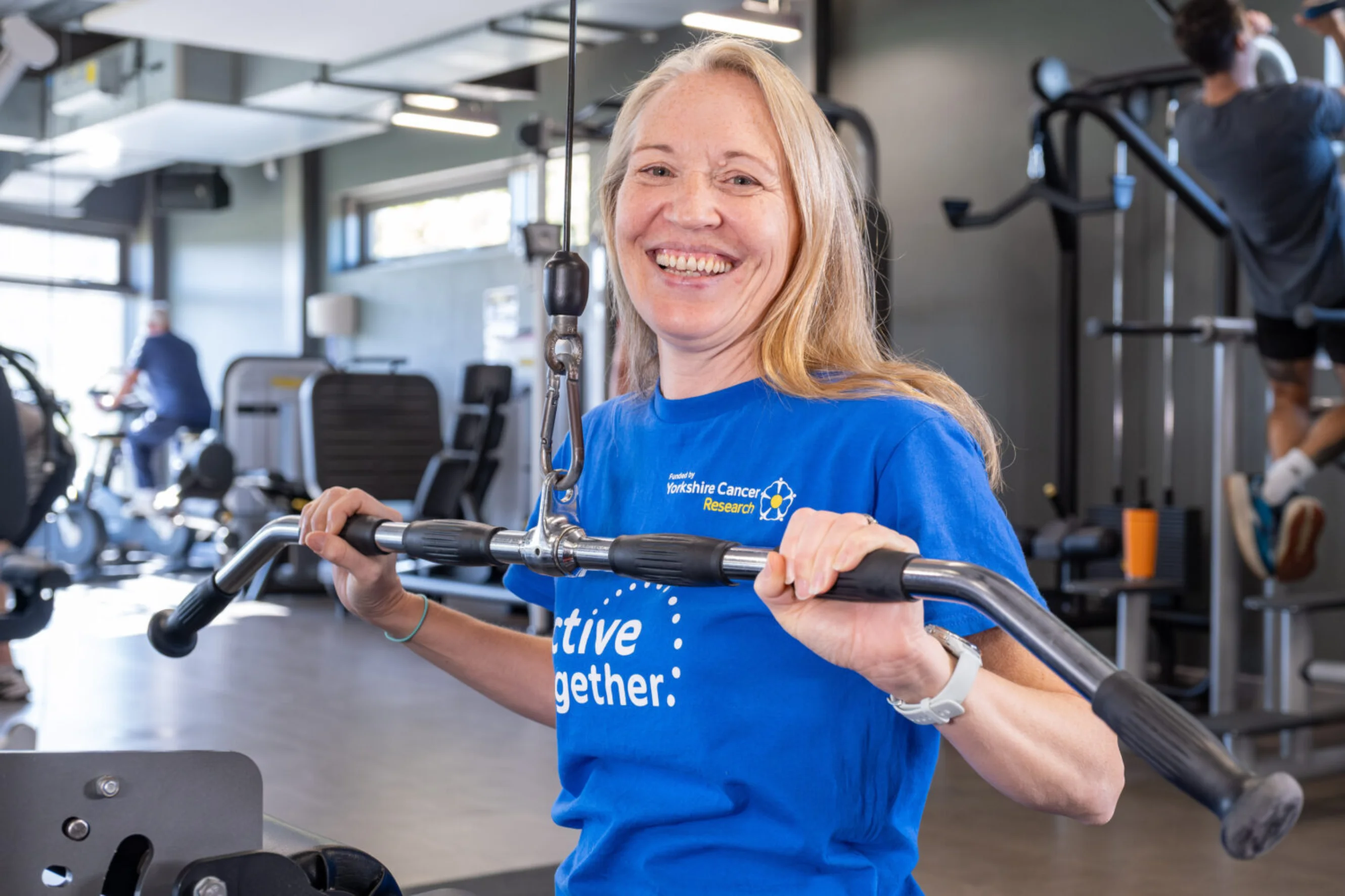
Having recently interviewed Yorkshire Cancer Research’s Chief Executive Dr Kathryn Scott for her LeadHERship Journeys podcast, Leona Deakin had admired the charity’s Active Together service from afar.
“Just hearing about Active Together in abstract really inspired me. I remember thinking it was a very cool thing,” the 53-year-old mum from Ilkley said.
Little did she know that just a few months later, she would become one of hundreds of people across Yorkshire who have benefitted from research-backed cancer exercise, nutrition and wellbeing support provided through the service.
In June 2025, Leona’s whirlwind life juggling a thriving career and a blended family was abruptly interrupted by a diagnosis of bowel cancer.
“I first noticed symptoms in autumn of 2024. I got a bit of dark red bleeding when I went to the toilet, but I just put it down to haemorrhoids, which I’d had before,” Leona explained. “Like many women my age, I also had symptoms of menopause, like tiredness and weakness. Every afternoon I’d feel completely wiped out, so I’d have a power nap or get a sugar or caffeine hit. Looking back now, that had been going on for a long time and was out of the ordinary.
"By springtime, something about my symptoms started to spook me. I supressed that feeling and just thought I was being a bit silly or dramatic. Living a very busy life, I also kept looking at my diary and deciding I couldn’t fit in a visit to the doctor. I kept pushing it down into the future.”
Inspired by journalist and bowel cancer awareness campaigner Dame Deborah James, Leona eventually found the time to visit her GP in June.
“There was something about Deborah’s experience that really pulled at my heart strings,” Leona said: “But there were also a few things she’d said about her symptoms that resonated with me. I knew I needed to get checked, and I suppose I have her to thank for making me a bit more aware of something going on in my body.”
Following tests, doctors confirmed that Leona had bowel cancer, and she was swiftly booked in for surgery just a month later.
Quote from Leona Deakin
While the tests were taking place, I jumped from thinking it was probably nothing to feeling like I needed to write a bucket list. As a psychologist, I already had some insight into resilience and the power of your own thoughts. But facing your own mortality brings a primal fear, so I feel fortunate that I was able to rely on those tactics to help me through.”
Doctors were confident that Leona’s cancer had not spread and that surgery alone would successfully treat it. Within two weeks, they were able to tell her that the lymph nodes near the tumour were clear of cancer, meaning she wouldn’t need chemotherapy.
Leona is thankful to researchers like Professor Philip Quirke for pioneering the keyhole surgery she benefitted from. Supported with funding from Yorkshire Cancer Research since 1984, Professor Quirke’s groundbreaking work revolutionised bowel cancer surgery for people in Yorkshire and around the world. His achievements include proving that keyhole surgery was a safe and effective way of removing bowel tumours.
Leona said: “Before I had cancer, I didn’t understand how many different variations there are. The fact that I happen to have had one that you can just cut out and throw away is quite amazing.
Quote from Leona Deakin
I’ve reaped the benefits of so many innovations in the treatment of bowel cancer. Thanks to people like Professor Quirke, I was able to have both keyhole surgery and a staple that means I don’t need to have a stoma. I feel very fortunate.”

Before her diagnosis, Leona was a keen runner, completing several half marathons and a marathon. Initially motivated by her father’s experience representing Great Britain at road running events in the 1970s, she found the hobby helped relieve stress and provided some much needed “me time” away from her busy life.
After surgery, Leona struggled to know how to start rebuilding her strength and fitness. That’s when she was contacted by the team at Active Together Airedale, which is provided in partnership with Airedale NHS Foundation Trust.
Designed by experts at Sheffield Hallam University’s Advanced Wellbeing Research Centre, the pioneering service is underpinned by well-established scientific evidence that shows exercise can increase survival, improve recovery from treatment and reduce the risk of cancer coming back.
Leona attended a fitness assessment with Active Together physiotherapists, who then designed a personal exercise treatment plan based on her needs and goals – including her aim to be able to run again.
She now has weekly sessions at Ilkley Lawn Tennis & Squash Club which include resistance training – something she had never considered before. The sessions have helped her not only understand whether she can safely carry a basket of washing upstairs but also how she can maintain her mobility in later life.

She has also benefitted from nutrition advice provided by the service’s dietitian and plans to take advantage of support from the service’s psychologist.
“The initial response from the NHS was amazing. They diagnosed me quickly, they treated me quickly and while I was in hospital the care was second to none,” Leona said. “But I went home without any advice about how I could move or what I could lift. And perhaps more importantly, for the type of surgery I had, they didn’t give me any dietary advice.
"I didn’t want to hurt myself, but I also wanted to get back to fitness. To have guidance from Active Together was brilliant. They provided me with practical, tangible things like how to make myself physically feel safe while getting stronger and fitter. They also gave me simple advice about what I should eat at a time when I was so anxious of doing something wrong.
“But as well as that, they gave me a bit of company on the journey, and I can’t tell you how much that means. I now feel confident, and that’s all down to the Active Together service. If I hadn’t had them, I don’t know where I’d be now.”
Leona praises the long-term benefits that Active Together provides and says the service has given her a “feeling of control”. But receiving exercise support has also reaffirmed her passion for the power of exercise on wellbeing and her belief that it should be an essential part of everyday life.
It’s powerful to think that I might be able to influence my health in the future by exercising well, eating well and managing stress,” Leona said. “As a psychologist, I understand the power of exercise for all aspects of life, not just keeping you alive longer but also for increasing your capacity for joy and peace of mind."
Quote from Leona Deakin
‘Cancer’ is such a massive word and it’s going to panic people, but going out and walking for 20 minutes in the fresh air is going to help you to manage that panic better. As well as having the physical benefits of making you stronger for surgery or for chemotherapy, it has those massive mental benefits of helping you take a breath and believe it’s going to be okay.”

Following her experience with cancer, Leona has taken a step back from her work as a psychologist and podcaster and is now planning to devote more time to writing novels. She’s also looking forward to spending more time with her husband, daughter and two stepchildren.
“I feel like I’ve dodged a bullet,” she added: “I feel like I’ve almost skipped past jail. I had cancer, but never knew I did, and when I did find out, I was so busy preparing for the operation that I didn’t really talk about it, and now I don’t have it anymore.
“Because it’s all happened so fast, I’m not sure whether the experience will fundamentally change my perspective on life. But I have gone back to writing because ultimately that’s my happy place. I’m concentrating on getting stronger and indulging in my passion. I’m also more appreciative of the relationships I have and hope to invest more in that in the future.”
“Active Together is about science, collaboration and compassion to give people the best chance of recovering from what can be the toughest period of their life” - Nick’s experience

After 20 years in the NHS supporting people with their nutrition, Nick Bergin from Skipton knows just how…
Pioneering research-backed cancer exercise treatment service launches in Airedale

People with cancer living in Airedale, Wharfedale and Craven are now able to benefit from Active Together,…
Active Together programme boosts survival by 10%

A pioneering exercise, nutrition and wellbeing programme funded by Yorkshire Cancer Research has been found…